Why washing technique matters as much as product choice
Most people focus on which shampoo to buy when thinking about washing their bundles. Product choice matters, but the technique you use during washing has just as much impact on how the hair holds up over time. The same sulfate-free shampoo can produce very different results depending on whether you work the hair in the right direction, use the right water temperature and handle the hair correctly when it is at its most vulnerable state: wet.
Wet hair is more elastic and more fragile than dry hair. The cuticle scales are partially open during washing, which means friction between strands during this window causes more damage than the same friction would during dry styling. Every time you scrub, rub or agitate wet bundles against each other, you are tangling cuticle scales and creating the micro-damage that accumulates over time into visible frizz, dullness and matting.
The correct washing technique minimizes this friction by keeping all strands moving in the same direction at all times: downward from root to tip, following the natural direction of the cuticle scales. This one principle, applied consistently through every washing step, makes a bigger difference to bundle longevity than almost any other single habit.
The golden rule of washing virgin hair: Always work in a downward direction from root to tip. Never scrub in circles. Never pile the hair on top of your head during washing. Never rub strands against each other. Every motion should be a smooth, downward stroke that keeps cuticle scales lying flat.
💧 Wash frequency calculator
Tell us about your lifestyle and we will tell you exactly how often to wash your bundles.
Wash every 8 days
Based on your lifestyle, washing every 8 days keeps your bundles clean without over-stripping moisture between sessions.
Before you start: what to do before water touches the hair
The preparation steps before washing are just as important as the washing itself. Getting these right prevents the most common washing mistakes before they happen.
Detangle while dry first. This is the most important pre-wash step and the one most people skip. Attempting to detangle wet, tangled hair causes significantly more breakage than detangling the same hair while it is dry. Use a wide-tooth comb or your fingers and work from the ends upward toward the roots in small sections. Never pull through a knot. Work it loose gently before continuing upward.
Do not wash over a sink. Washing bundles over a sink means the hair is folded, bent or bunched against the basin surface during the wash, which creates exactly the kind of directional confusion and friction that causes tangling. Wash in the shower where the hair can hang freely and all water flows in one downward direction, or lay the bundles flat on a clean surface and work over them.
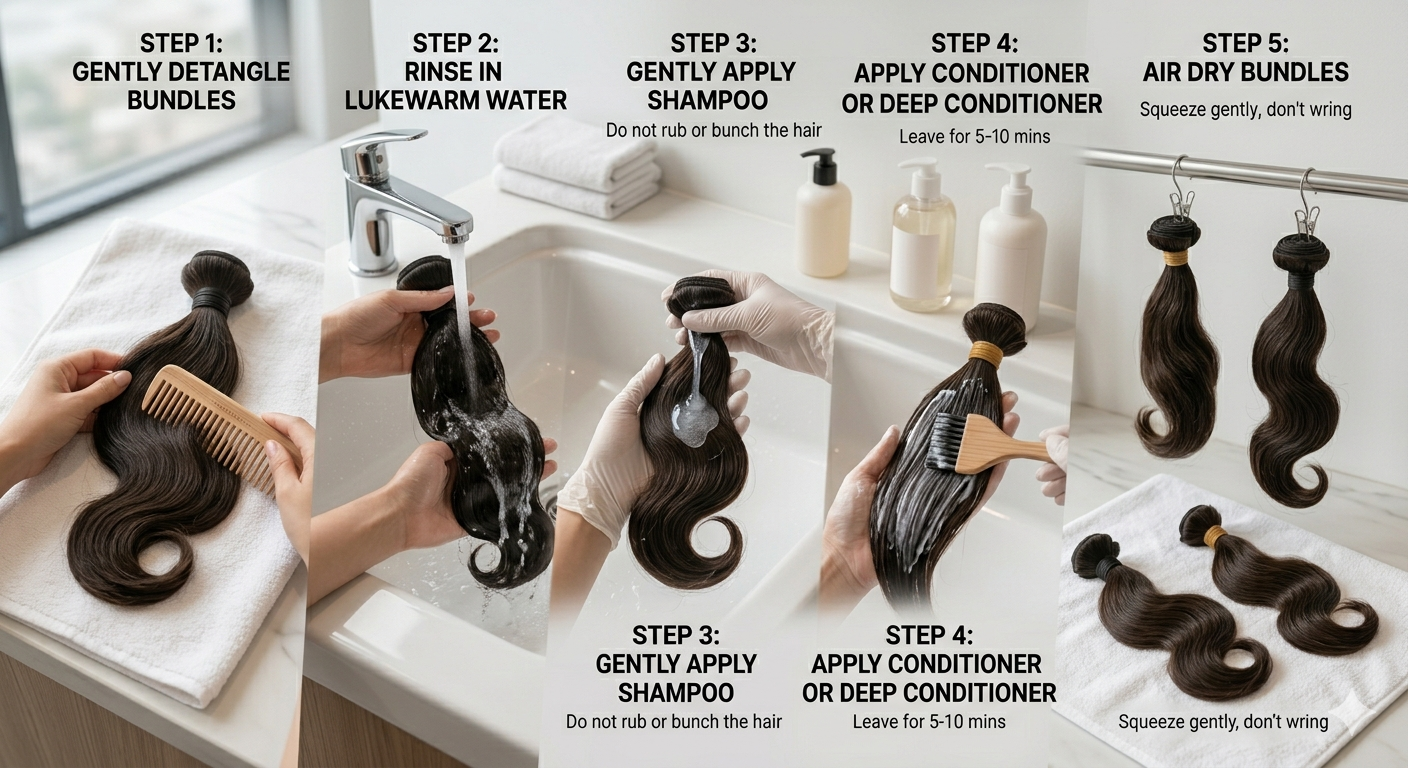
Detangle completely while dry
Starting at the ends, use a wide-tooth comb or your fingers to gently detangle the entire bundle before any water touches the hair. Work in small sections, releasing knots from the bottom upward. This is non-negotiable: wet tangled hair breaks far more than dry tangled hair.
Rinse with warm water in one downward direction
Hold the bundle at the top and let warm water run through it from root to tip. Never flip the hair upside down or pile it up during rinsing. Always keep the strands flowing downward in one direction. This initial rinse softens the hair and begins removing surface debris before shampoo is applied.
Apply sulfate-free shampoo with downward strokes
Put a small amount of sulfate-free shampoo into your palms and work it together before applying. Run your hands through the hair from root to tip using long downward strokes. Never scrub in circles. Never rub the hair against itself. The goal is to let the shampoo do the cleaning while your hands guide it through in the direction of the cuticle.
Rinse thoroughly, still working downward
Rinse all shampoo out with warm water using the same downward motion you used to apply it. Continue rinsing until the water runs completely clear with no suds remaining. Shampoo residue left in the hair continues stripping moisture after you finish washing and contributes to progressive dryness.
Apply conditioner from mid-shaft to ends
Squeeze out excess water gently, then apply conditioner starting at the mid-shaft and working to the ends. The roots of extension hair do not need conditioning and heavy conditioning near the weft can loosen the weft construction over time. For regular washing, leave the conditioner on for 3 to 5 minutes. For a deep conditioning session, cover with a plastic cap and leave for 20 to 30 minutes.
Final rinse with cool water only
This is one of the most impactful steps and the most commonly skipped. Rinsing with cool water closes the cuticle scales after washing, sealing in the moisture from the conditioner and giving the hair a smoother, shinier surface. The difference between warm and cool final rinse is immediately visible in the glossiness and smoothness of the finished hair.
Gently squeeze and air dry
Never wring, twist or rub the hair with a towel. Gently squeeze the hair from root to tip to remove excess water. Use a microfiber towel if you have one as the smoother surface causes less friction than regular terry cloth. Air drying is the best option. If you use a blow dryer, low heat only with a diffuser attachment. Never go to bed with wet bundles.
Washing do's and don'ts: the complete reference
Everything that helps and hurts your bundles during washing, in one place.
The right products for washing virgin hair bundles
Extension hair cannot replace its own moisture from the scalp the way natural hair does. This makes product selection critically important because the products you use are the only source of moisture replenishment the hair gets between washes.
Research published in the National Institutes of Health database on hair fiber chemistry confirms that anionic surfactants, the chemical family that includes sulfates, cause measurable disruption of the hair cuticle surface with each wash and remove a significant portion of the intercellular lipids that keep the cuticle scales lying flat and protect the cortex from moisture loss. The same research shows that amphoteric and non-ionic surfactants, which are the active cleaning agents in most sulfate-free formulas, achieve comparable cleansing with significantly less cuticle disruption.
Sulfate-free shampoo
Always useMoisturizing conditioner
Every washDeep conditioner or hair mask
Every 1 to 2 weeksLight sealing oil
After washingSulfate shampoo
Never useAlcohol-based sprays
AvoidDeep conditioning: the most important step most people skip
A regular conditioning rinse adds surface moisture to the hair. Deep conditioning penetrates the cortex and provides sustained hydration that keeps the hair elastic, pliable and resistant to tangling over time. The difference between hair that is regularly deep conditioned and hair that only receives rinse-out conditioning becomes increasingly visible as months of wear accumulate.
Deep conditioning should happen every one to two weeks during active wear. After bleaching or significant heat styling, deep conditioning every seven days for the following month is strongly recommended. After coloring, switch to a color-safe deep conditioner to protect the shade while still providing the same hydration benefit.
The U.S. Food and Drug Administration publishes guidance on cosmetic hair conditioning products including deep conditioners and hair masks. While the FDA does not regulate which products are best for extension hair specifically, its guidance on ingredient safety is useful for anyone building a hair care routine.
Regular conditioning
Deep conditioning
Moisture retention by washing method
How well each approach preserves moisture in the hair strand over time.
Scores represent approximate relative moisture retention over a 3-month washing period. Not clinical measurements.
How to wash bundles while they are installed
The process for washing installed bundles follows the same principles as washing loose bundles with a few additional considerations for the scalp and braid-down underneath.
Use a diluted sulfate-free shampoo applied directly to the scalp along each part. Massage gently with your fingertips rather than your nails and allow the diluted shampoo to rinse through the bundles without direct scrubbing of the hair itself. Rinse thoroughly from roots to ends as usual.
The most critical difference when washing installed hair is drying. The braid-down underneath the wefts holds moisture much longer than the visible hair above. If you go to sleep before the braid-down is completely dry, the trapped moisture creates conditions for mildew, which produces an odor that is very difficult to fully remove from installed hair. Dry under a hooded dryer or use a blow dryer on low heat to accelerate drying of the braid-down specifically, not just the visible hair above the weft.
The U.S. National Library of Medicine maintains guidance on scalp conditions that can develop during extended protective style wear, including seborrheic dermatitis and scalp folliculitis, both of which are more common when the scalp is not washed regularly or is kept consistently damp. Regular washing of installed hair is important for scalp health, not just hair appearance.
| Shampoo type | Safe for bundles? | Cuticle impact | Frequency |
|---|---|---|---|
| Sulfate-free moisturizing | Yes, always use | Minimal disruption | Every 7 to 10 days |
| Sulfate-free color-safe | Yes, after coloring | Minimal, protects color | Every 7 to 10 days |
| Clarifying sulfate-free | Occasionally only | Moderate, removes buildup | Once a month maximum |
| Regular sulfate shampoo | No, avoid entirely | High, strips moisture | Never recommended |
| Baby shampoo | With caution | Low but limited cleansing | Not ideal for buildup |
| Dry shampoo | Between washes only | None on strand | Occasional refresh only |
Every washing session is either adding to the life of your bundles or subtracting from it. The right technique with the right products adds months. The wrong technique with the wrong products removes them just as fast.
Pink Lemon HairFrequently asked questions
How often should you wash hair bundles?
Can you wash hair bundles while installed?
What shampoo should I use on virgin hair bundles?
Should I wash hair bundles before installing?
How do you dry hair bundles without heat damage?
How long does it take to deep condition hair bundles?
Why does my hair tangle after washing?
More care guides
Shop hair that washes beautifully every time
Pink Lemon 13A virgin bundles are cuticle aligned and tangle-free from day one. Built for the wash routine this guide describes.
Shop 13A bundles ↗