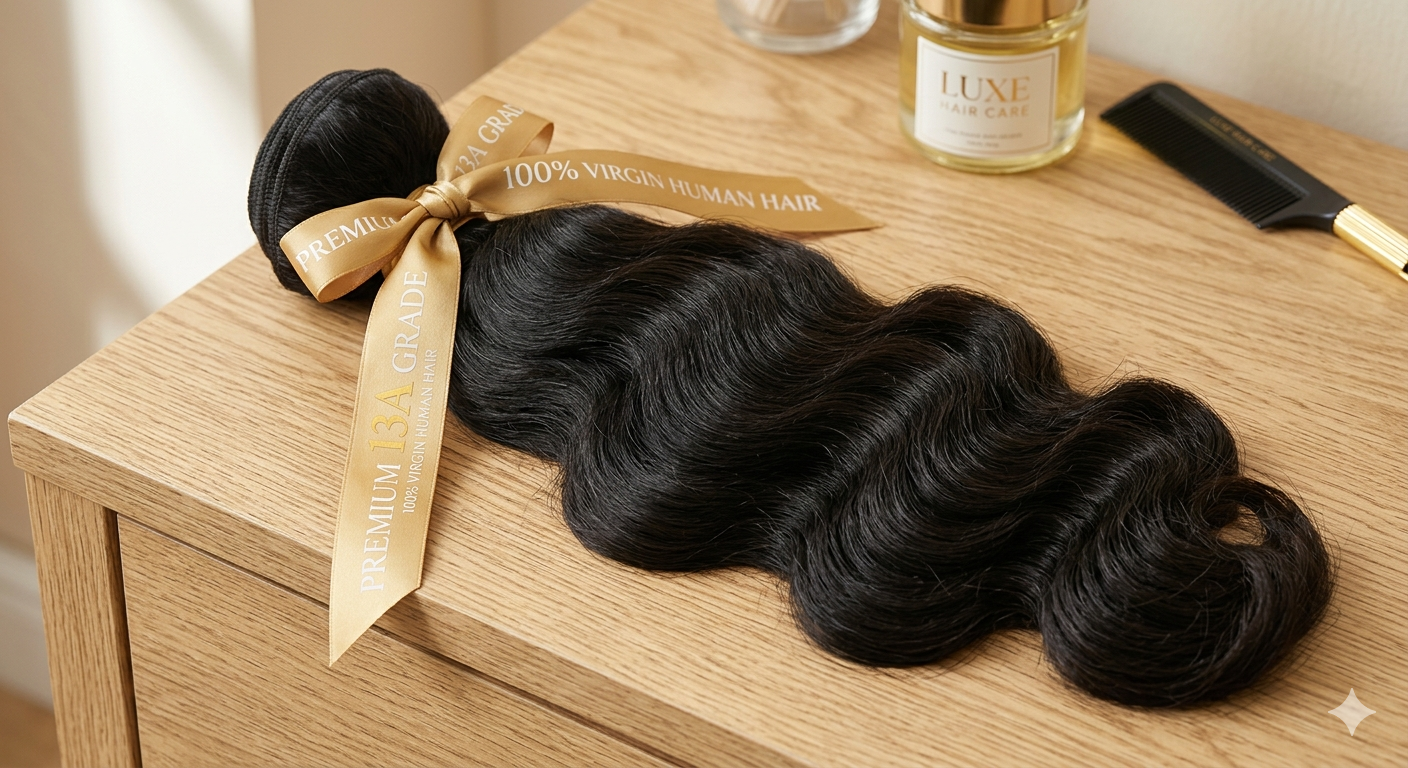

The hair grading system explained
The human hair grading system is an industry standard used to classify the overall quality of hair bundles. Grades run from 3A at the lowest end to 13A at the highest. Each step up the scale reflects improvements in cuticle alignment, strand consistency, absence of shedding and the degree to which the hair has been chemically processed or treated before sale.
It is important to understand that the grading system is not officially regulated by any single global authority. Different suppliers and countries use slightly different scales, and the criteria for each grade can vary. However, the broad framework is widely adopted across the human hair industry and reflects genuine, observable differences in hair quality at each level.
The U.S. Food and Drug Administration classifies hair extensions and wigs as cosmetic products. While the FDA does not regulate hair grading specifically, it does govern the safety of any chemicals used in hair processing, which directly affects the quality and safety of lower-grade hair products that rely on chemical treatments to appear soft and manageable.
Why grades matter for buyers: A 5A bundle and a 13A bundle can look identical in a product photo. The difference only becomes visible after washing, heat styling and several weeks of wear. Lower-grade hair relies on silicone coatings and chemical treatments to look smooth at the point of sale. Once those coatings wash off, the hair tangles and mats rapidly. 13A hair has no coating to wash off because the cuticle alignment is doing that work naturally.
The hair grade scale at a glance
Pink Lemon sits at the very top of the scale. The pointer shows where 13A falls.
What cuticle alignment actually means and why it matters
The cuticle is the outermost layer of a hair strand. It is made up of overlapping scales, similar to roof tiles or fish scales, that lie flat against the strand when the hair is healthy. These scales all point in the same direction: from root to tip.
When all the cuticle scales on all the strands in a bundle are pointing in the same direction, the bundle is described as cuticle aligned. This alignment is what gives high-grade virgin hair its smooth, tangle-free quality. When you run your fingers down a cuticle-aligned bundle, the scales all lie flat and the strands glide past each other easily. When you run your fingers up, you feel slight resistance. This is completely normal and is a sign of healthy, intact cuticles.
Cuticle alignment is not cosmetic. It is the single structural property that determines whether your bundles last six months or two years. Everything else is secondary to this.
Pink Lemon HairWhen cuticle scales are misaligned or damaged, the opposite happens. Strands from different parts of the bundle catch on each other because their cuticle scales are pointing in different directions. This creates friction at the microscopic level that leads to tangling, matting and eventually irreversible knotting of the hair over time.
Research published in the National Institutes of Health database on hair fiber morphology confirms that cuticle integrity is the primary determinant of hair smoothness, combing resistance and overall fiber quality. The same research shows that chemical processing, even gentle treatments, disrupts the cuticle surface in measurable ways that affect how hair behaves during washing and styling.
Cuticle aligned vs cuticle damaged: what it looks like
The cuticle structure is invisible to the naked eye but determines everything about how hair feels and lasts.
✨ 13A aligned cuticle
All cuticle scales lie flat in one direction. Smooth, tangle-free, long-lasting.
⚠ Misaligned / damaged cuticle
Cuticle scales point in mixed directions. Creates friction, tangling and early matting.
What separates 13A hair from lower grades
The difference between 13A and lower grades like 8A or 10A is not just marketing language. There are specific, observable characteristics that separate the top of the scale from everything below it.
Cuticle alignment
At 13A grade, all strands in the bundle have intact cuticles aligned in a single direction from root to tip. This is the defining characteristic of top-grade hair and the hardest to achieve consistently because it requires sourcing and handling the hair with extreme care throughout the entire production process.
Strand thickness consistency
High-grade hair has consistent strand thickness from root to tip, what industry professionals call full cuticle or double drawn hair. Lower-grade hair is often thinned toward the ends because shorter strands have been removed to reduce weight and cost, creating an install that starts full at the root and tapers noticeably toward the tip.
Absence of chemical processing
True 13A hair is completely unprocessed. It has never been dyed, permed, relaxed or treated with silicone coatings to improve its initial appearance. Lower grades frequently rely on these treatments to look good at the point of sale, but the treatments wash out or degrade over time, revealing lower-quality hair underneath.
Shedding resistance
Properly constructed 13A wefts have minimal shedding because the strands are tightly secured in the weft construction. Lower-grade hair often sheds significantly during the first few washes as poorly secured strands release from the weft. Excessive shedding in the first week of wear is a reliable indicator of lower-grade hair regardless of what grade is printed on the label.
Grade comparison table: 8A vs 10A vs 13A
Here is the full side-by-side breakdown of what changes as you move up the grade scale. The highlighted row is the Pink Lemon standard.
| Quality factor | 8A grade | 10A grade | 13A grade (Pink Lemon) |
|---|---|---|---|
| Cuticle alignment | Partial | Good | Full alignment |
| Processing | May be lightly processed | Minimal processing | 100% unprocessed virgin |
| Silicone coating | Often coated | Lightly coated | No coating |
| Strand thickness | Tapered at ends | Mostly consistent | Full root to tip |
| Shedding | Moderate to high | Low to minimal | Minimal |
| Tangle resistance | Low after washing | Good | Excellent |
| Color ready | Somewhat | Yes | Excellent color uptake |
| Expected lifespan | 6 to 12 months | 12 to 18 months | 1 to 2 years+ |
| Reinstallable | Limited reinstalls | 2 to 3 reinstalls | Multiple reinstalls |
How to verify hair quality before you buy
Because the grading system is not officially regulated, unscrupulous sellers sometimes label lower-grade hair with higher grade numbers to justify a premium price. Knowing how to verify quality before and after purchase protects your investment.
The finger slide test
Run your fingers from root to tip and then from tip to root. High-grade cuticle-aligned hair should feel smooth going root to tip and slightly resistant going tip to root. If it catches or tangles in both directions, the cuticle is damaged or misaligned.
The water test
Wet a small amount of hair. High-grade virgin hair should feel similar wet and dry, remain tangle-free when wet and dry without significant frizzing. If the hair becomes rough or tangles when wet, it is likely coated with silicone that is masking poor cuticle quality.
The burn test
A small strand of genuine human hair burns slowly, curls away from the flame and produces a smell similar to burning skin or fingernails. Synthetic or heavily processed hair burns quickly, melts and produces a plastic smell. Use extreme caution if attempting this test.
The shed test after washing
Wash the bundles before installing. Some shedding of short strands is normal. Excessive shedding, where significant amounts of hair come out with each rinse, indicates poor weft construction or lower-grade hair regardless of the grade printed on the label.
Why 13A hair is worth more than lower grades
The price difference between 8A and 13A hair at the same length is real, and so is the value difference. When you calculate cost per month of wear rather than upfront price, 13A hair almost always comes out as the more economical choice.
A set of 8A bundles that lasts six months and costs a certain amount has a higher monthly cost than 13A bundles that last twenty-four months, even if the 13A set costs twice as much upfront. Factor in the time, installation cost and disruption of more frequent replacements and the gap widens further.
The U.S. National Library of Medicine provides research-backed information on hair and scalp health that is relevant to anyone making long-term decisions about extension wear. In particular, research on traction alopecia and scalp health during extended protective style wear underscores the importance of high-quality extensions that can be reinstalled multiple times rather than lower-grade alternatives that require more frequent replacement and more frequent installation stress on the natural hair underneath.
Think in cost per month, not upfront cost: 13A hair that lasts two years and is reinstalled three times costs significantly less per month than lower-grade hair that needs replacing every six months. The upfront price is higher but the total cost over two years is lower in almost every scenario.
There is also a scalp health argument. Lower-grade hair requires more frequent installation and takedown cycles, which means more manipulation of the natural hair and scalp at the hairline and crown. These are the areas most vulnerable to traction stress. Fewer installs over the same time period means less cumulative tension on the most fragile parts of the natural hair.
13A hair and color: why grade affects how your dye takes
One of the clearest practical demonstrations of why grade matters is what happens when you color the hair.
Lower-grade hair that has been coated with silicone or lightly processed resists color penetration. The cuticle does not open evenly across the strand, which causes patchy, uneven color results. When the silicone coating washes out over time, the color fades differently in different areas of the strand, creating a multicolored or streaked appearance that is difficult to correct.
True 13A virgin hair has an intact, uncoated cuticle that opens evenly when exposed to developer and accepts color uniformly across every strand. When you rinse and the cuticle closes back down, it seals the color inside the strand. The result is a more consistent, more vibrant and longer-lasting color result than you can achieve on lower-grade hair.
This is why the most dramatic color transformations, including 613 platinum blonde lifts on black hair, are performed almost exclusively on high-grade virgin hair. The cuticle integrity is what allows the bleach to penetrate without the strand breaking down in the process. For a full guide to coloring virgin hair safely, read the how to bleach virgin hair guide.
Frequently asked questions
What does 13A grade hair mean?
What is the difference between 10A and 13A hair?
Is 13A hair really virgin hair?
How long does 13A grade hair last?
Can you dye 13A grade hair?
Is the hair grading system regulated?
How can I tell if hair is really 13A grade?
Continue reading
Shop the highest grade available
Pink Lemon Hair 13A virgin bundles are 100% unprocessed, cuticle aligned and built to last up to two years with proper care.
Shop 13A bundles ↗